1925–26Origins
In 1925 and 1926, a group of Japanese-Canadian veterans of the First World War organized their own branch of the Canadian Legion of the British Empire Service League (the forerunner of today's Royal Canadian Legion), based in Vancouver's Powell Street district — the heart of the community then known as Japantown. It was registered as British Columbia Branch No. 9.
The branch's first president was Sergeant Masumi Mitsui, a decorated veteran of the 10th Battalion who had earned the Military Medal at the Battle of Hill 70 in 1917. Roughly 200 Japanese Canadians served in the Canadian Expeditionary Force during the First World War — a striking number given that British Columbia's laws at the time barred Japanese Canadians (along with Chinese Canadians and Indigenous peoples) from voting, and many had to travel to Alberta to enlist because BC recruiting stations turned them away.
Sergeant Masumi Mitsui Remembered
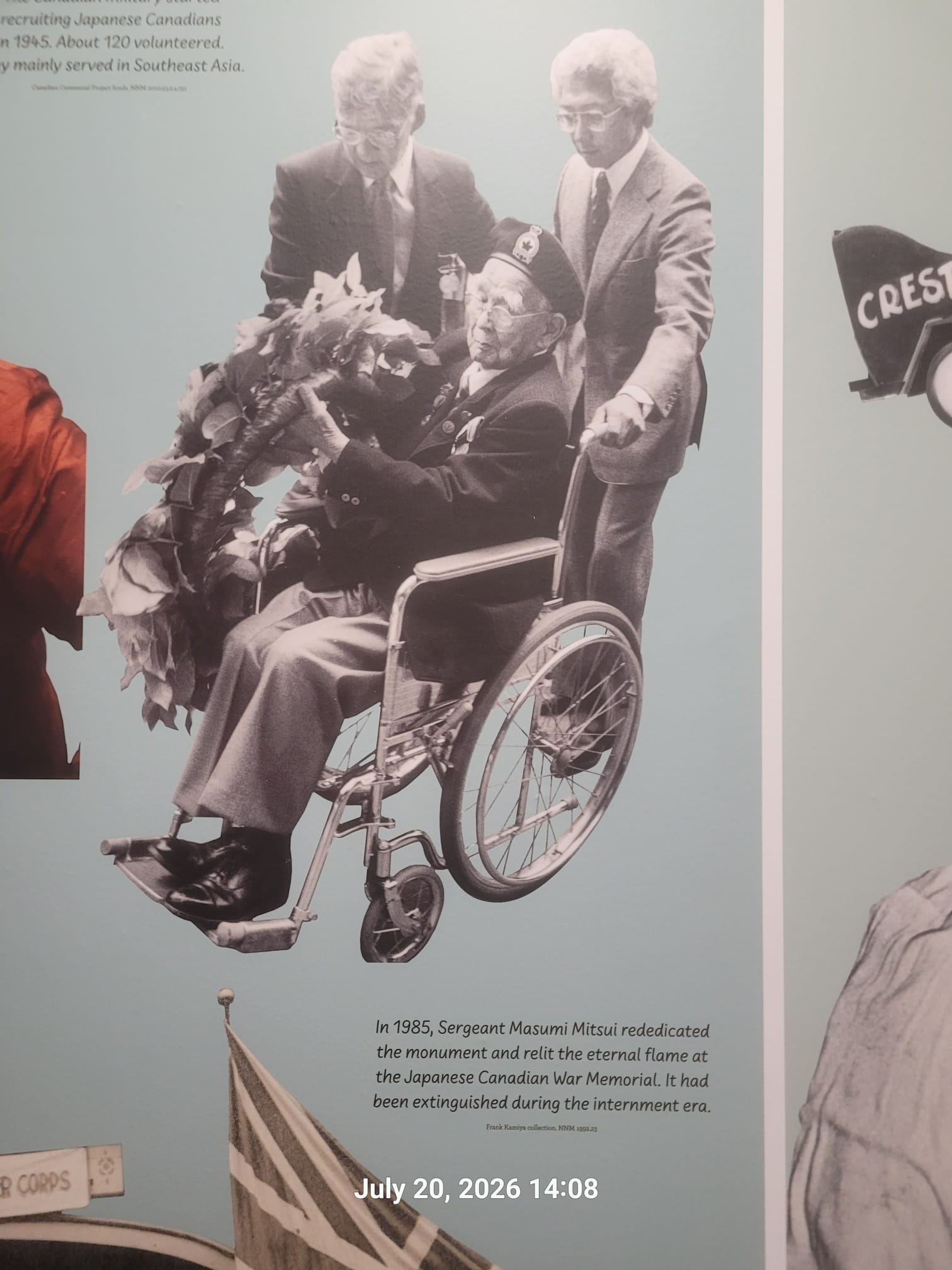
Sergeant M. Mitsui, MM, remained a powerful symbol of Japanese Canadian wartime service and civic courage into his final years. He served with the 10th Battalion, Canadian Expeditionary Force, and earned the Military Medal for gallantry during the First World War, including at the Battle of Hill 70 in August 1917. His later public acts of remembrance connected the sacrifices of Japanese Canadian soldiers with the community’s continued struggle for dignity, recognition, and equal rights.
Read the Hill 70 page: Non-White Canadians at the Battle of Hill 70.
1931The Fight for the Vote
Branch 9 spent years lobbying the BC legislature, arguing that men who had fought and died for Canada deserved the right to vote in the province they called home. On April 2, 1931, the BC legislature voted to extend the provincial franchise to Japanese-Canadian veterans of the First World War — passing by a single vote, 19 to 18.
It was a narrow, hard-won, and limited victory: it applied only to veterans, not to the wider Japanese-Canadian community, who would not win the vote in BC until 1949. But it made those veterans the first Japanese Canadians — and among the first Asian Canadians — to win the franchise in British Columbia, a province that had built an extensive legal architecture of racial exclusion around voting rights.
1942Wartime Suspension
Following the attack on Pearl Harbor in December 1941, the federal government invoked the War Measures Act, stripped Japanese Canadians of their property and civil rights, and forcibly relocated over 20,000 people from the BC coast in 1942 — Legion veterans included, regardless of their service or medals. Branch 9's charter was suspended that March.
As the community was forced from Vancouver, Corporal Sainosuke Kubota — the branch's secretary — took the branch's Roll of Honour and Legion flag with him into internment. He is reported to have safeguarded both for roughly twenty-five years, before returning them to Vancouver for the Japanese-Canadian centennial commemorations in 1977.
Masumi Mitsui, who had led Branch 9 and fought for the vote a decade earlier, was interned along with his family. In a bitter irony often noted by historians, the same government that had, by one vote, recognized his right to citizenship in 1931 stripped him and his community of their homes, businesses, and freedom eleven years later.
2024The Richmond Connection
Branch 9's roots are in Vancouver, but Richmond has its own direct thread to this history. Richmond-based historian Debbie Jiang researched two Japanese-Canadian soldiers with ties to the city — Private Hikotaro Koyanagi and Private Kazuo Harada — who fought and died within nine months of each other during the First World War, and whose names had never appeared on a local memorial.
Jiang's advocacy led to both names being added to the City of Richmond cenotaph, rededicated on October 4, 2024, in a ceremony organized with Royal Canadian Legion Branch 291 — the current Legion branch serving Richmond. That project is the same body of research Jiang has continued to build on since.
2026Where Things Stand
On July 15, 2026, at the Veterans' Dinner hosted by Royal Canadian Legion Branch 291 in Richmond, historian Debbie Jiang announced an effort to reinstate Branch 9 — the historic Japanese-Canadian Legion branch suspended in 1942 — this time open to all members, not restricted by ancestry. According to accounts from members present, Jiang's research also holds that an earlier attempt to reinstate the branch after the Second World War narrowly failed by a single vote, around the period when the Canadian Citizenship Act of 1947 first created "Canadian citizenship" as a legal status distinct from British subject status.
- Independently verifiable history (Sections 1–4 above) is drawn from published sources — Legion Magazine, the Vimy Foundation, the National Association of Japanese Canadians, and others — linked in the Sources section below.
- The 2026 reinstatement announcement and the post-WWII "lost by one vote" detail come from a firsthand account of the July 15, 2026 Veterans' Dinner at RCL Branch 291, relayed to this page's author by a Branch 291 member who attended. As of this writing, no published source, Legion press release, or BC/Yukon Command notice confirming Branch 9's reinstatement has been found. RCL Branch 9 does not yet hold official Royal Canadian Legion charter status — the process is reported to be underway and, by all accounts here, close to completion, but it is not yet finalized.
This page will be updated as the reinstatement process moves forward and as official confirmation becomes available. If you have documentation, dates, or corrections, they are welcome — this is a living record of a story still being written.
Sources
The historical sections of this page (1925–2024) draw on the following published sources:
- Vimy Foundation — "Sgt Masumi Mitsui MM: A Lifetime of Service"Branch 9's founding, Mitsui's WWI service and Military Medal, internment.
- Wikipedia — "Masumi Mitsui"Biographical summary and Branch 9 presidency.
- National Association of Japanese Canadians — ResourcesMore history of Japanese Canadians
- Legion Magazine — "Forgotten Japanese-Canadian soldiers added to Richmond, B.C., cenotaph"Debbie Jiang's research on Pte. Koyanagi and Pte. Harada; the October 2024 Richmond cenotaph rededication.
- CBC News — "Japanese-Canadian WWI veterans, once forgotten, remembered by new plaque"Background on Japanese-Canadian WWI service and commemoration efforts.
- Richmond News — "Richmond author receives BC history award for advocacy work"Debbie Jiang's BC Historical Federation Bright Light Advocacy Award and background.
The 2026 reinstatement details are sourced as described in the "Where Things Stand" section above and are not yet independently published.